Carpenter ant structural remediation addresses species like Camponotus pennsylvanicus, which excavate smooth galleries inside damp structural timbers rather than consuming the wood itself. In historic Boston…
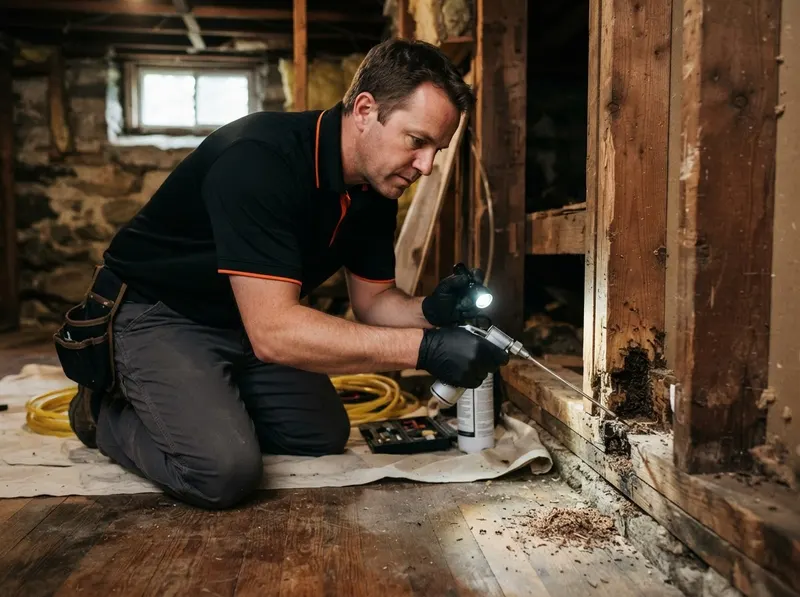
Carpenter ant structural remediation addresses species like Camponotus pennsylvanicus, which excavate smooth galleries inside damp structural timbers rather than consuming the wood itself. In historic Boston architecture, such as row houses in Back Bay and the South End with heavy heart-pine timber, or multi-family triple-deckers in Dorchester and Jamaica Plain, colonies routinely exploit moisture leaks around flat roof edges, unlined masonry parapets, and original rubblestone foundations. The primary distinction between basic surface spraying and full structural remediation lies in reaching the parent nest. Surface treatments only kill foraging workers (roughly 10% to 15% of the colony population), leaving the reproductive queen and brood intact deep inside framing lumber. Structural remediation deploys calibrated non-repellent transfer insecticides and micro-injection directly into active gallery networks, ensuring the active agent is brought to the core nest without broad-spectrum chemical exposure in living quarters.
Selecting structural remediation fits scenarios where coarse sawdust-like frass containing insect parts accumulates beneath baseboards, or where winged swarmers emerge indoors between April and July. If moisture damage is confined to a single bathroom subfloor without gallery excavation, basic moisture remediation and spot sealing suffices. The technical trade-off involves opening targeted diagnostic access points: small 1/8-inch access holes drilled directly into wall plates or baseboard tracks are required to inject micro-foam agents into wall cavities, which avoids tearing out plaster or historic lath but requires precise patching afterward. Properties located near mature tree canopies, such as homes bordering the Arnold Arboretum or Boston Common, often support multiple outdoor parent colonies that trail through utility lines and overhanging branches directly into third-story gutters.
Diagnostic protocols incorporate precise steps to establish structural defense. 1. Technicians survey the exterior perimeter and interior foundation lines using calibrated pinless moisture meters to map elevated water zones exceeding 18% moisture content in wood framing. 2. Acoustic monitoring tools track colony movement inside wall assemblies without drywall demolition. 3. Precision void injection deposits slow-acting insect growth regulators and targeted transfer actives directly into structural galleries. 4. Seal-up technicians plug masonry penetrations, replace damaged insulation barriers, and seal gaps around service conduit lines in Charlestown, East Boston, Brighton, and South Boston. Nuvexa Bug Control structures treatments to safeguard family members and domestic pets, prioritizing localized placement behind wall barriers over ambient chemical broadcast.
Every job gets a firm, written price after a free on-site visit.
Tell us about your carpenter ant structural remediation job in Boston and we'll send a clear, written quote, usually the same day.
 Nuvexa Bug Control